MCMA Verona 2026 · After the show
Thank you for visiting us at MCMA Verona: here is what we talked about
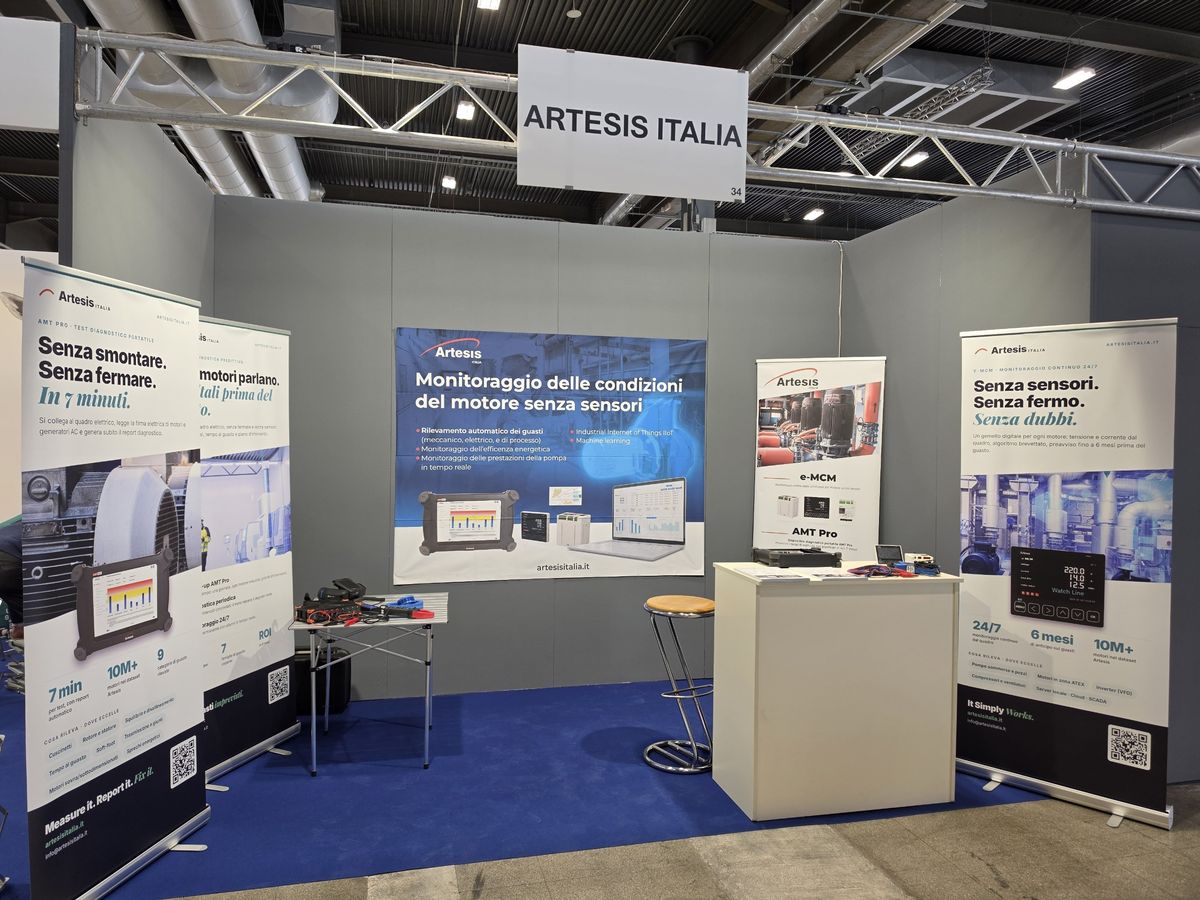
On 7 and 8 October, at Stand 34 in Hall 4 of Veronafiere, we had lots of questions and many practical conversations, often about a real problem waiting to be solved. Here is a summary of the topics we discussed most, for those who were there and for those who could not make it.
1.The motor is already a sensor
Every electric motor “tells” the condition of the whole train it drives: motor, coupling, transmission, pump, fan or compressor. All it takes is reading voltage and current from the electrical panel. No sensors on the machine, no field cabling and no production stop.
2.Every machine compared with itself
Artesis technology does not rely on generic thresholds. During a learning phase it builds a model of each individual machine in its real operating conditions, and from then on it measures the deviations. The result is a more targeted diagnosis and fewer false alarms.
3.What you can see from the panel
- Process side: clogging, impeller wear, air entrainment, unstable operation or excessive cycling.
- Mechanical side: unbalance, misalignment, looseness, driven-equipment problems and anomalies pointing to bearing degradation.
- Electrical side: phase imbalance, harmonics, rotor and stator problems.
It does not replace vibration analysis where that is already in place: it sees what vibration alone cannot see, and it reaches where sensors cannot.
4.Machines you cannot reach
Submersible pumps, wells and lift stations are where this approach makes the biggest difference. The machine is under water, but the panel is dry and accessible. At the show we told the story of a 3.3 kV submersible pump: the electrical panel flagged an unbalance and, once the pump was pulled out, a piece of wood was found stuck in the impeller.
5.A diagnosis that tells you what to do
With the latest version of OmniSight, the continuous monitoring platform, the system does more than flag an electrical anomaly. It compares the machine with its own learned reference and, where the data supports it, tells a winding problem apart from a high-resistance connection. The first calls for a planned shutdown and a winding test, the second for a check of the terminal box: very different jobs, timescales and budgets. The system tells you when an insulation test is worth doing; it does not replace it.
6.Pumps: flow and energy, with numbers you can trust
OmniSight estimates pump flow without a flow meter, starting from the manufacturer’s curves, which can be loaded straight from the PDF datasheet. Every value comes with its uncertainty band and a confidence grade. Where an estimate would not be reliable on a given pump, the system says so and names the input that would make it possible. Potential energy savings are calculated from the pump’s real curves and your own tariff, and shown as a range, not as a promise.
7.Alarms that fit your plant
Alarms can be set on any recorded parameter, such as flow, head or current unbalance, across the whole plant, an area or a single machine. The rule automatically applies to machines added later as well.
8.Not the same as drive-based monitoring
Some variable-speed drives offer monitoring functions, useful as a first alarm on the motors they control. Artesis diagnostics, on the other hand, work on any motor, whether direct-on-line, soft-started or driven by an inverter of any brand, and give an independent view of the whole fleet.
How to get started
- AMT Pro, the measurement day: with the portable instrument we measure your most critical motors directly from the panel. For each machine you receive a report with its health status and recommended actions.
- e-MCM and OmniSight, continuous monitoring: for critical machines, the e-MCM is installed in the panel and watches the machine around the clock. OmniSight brings the data from all your sites together in a single view.
Is there a machine you are worried about?
Or one you cannot monitor today? Let’s check it together with a measurement day.